
The Staffing Trap Keeping Community FIs From Growing
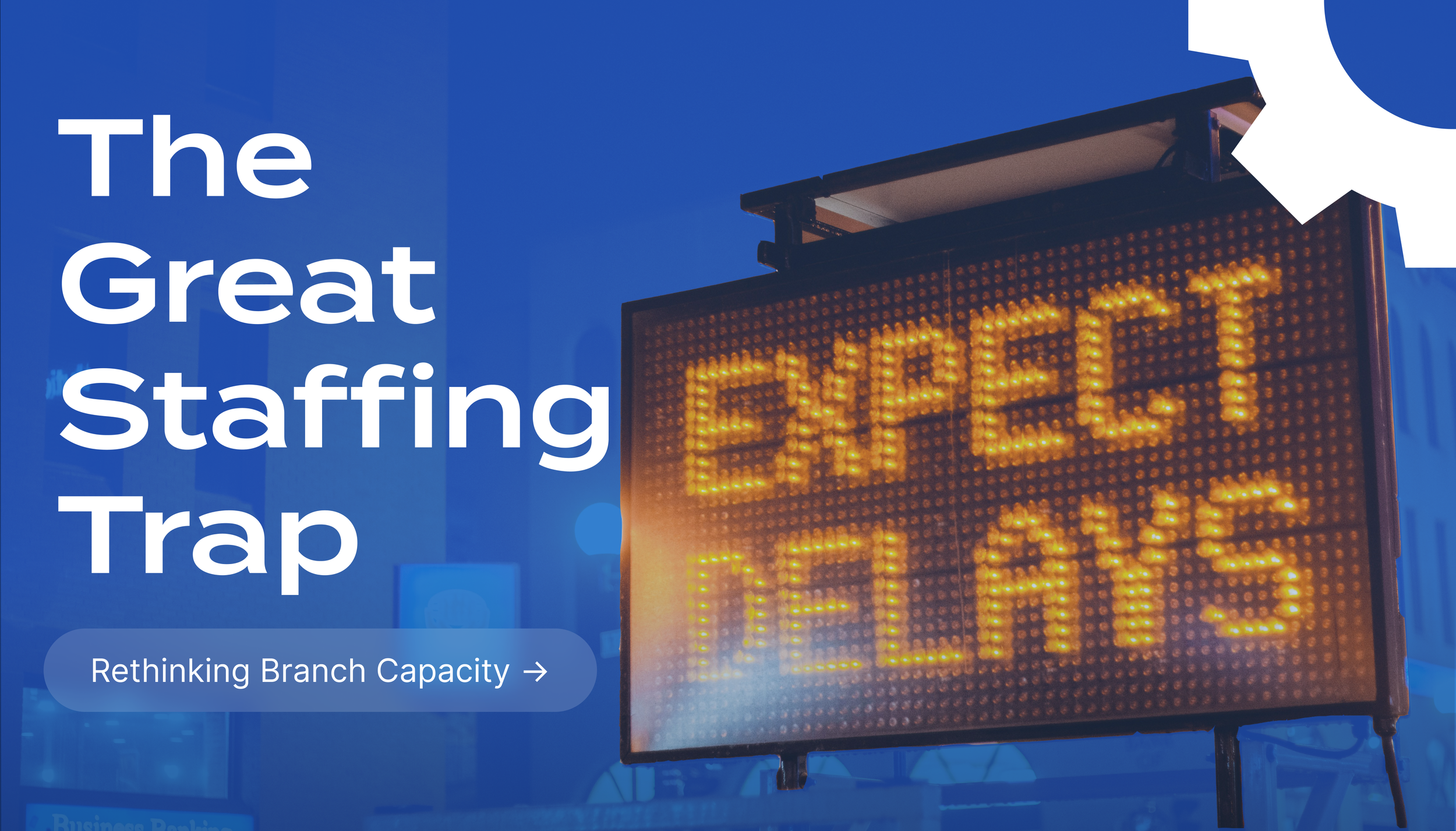
A financial institution’s ability to recruit doesn’t always correlate with its ability to expand. But not enough FIs know that.
Hiring and retaining branch staff has always been a challenge for community financial institutions. But in recent years, it has become something else entirely: a ceiling on growth.
60% of retail branch employees leave their jobs within a year. When they do, it takes an average of 45 days to find a replacement. That’s 45 days of reduced capacity, strained remaining staff, and customers receiving less service than they expect. Multiply that across a network of branches, and the math becomes unsustainable fast.
For many community FIs, the response has been to double down on the same strategy: post more listings, offer higher wages, and hope that recruitment improves. But hope is not a growth strategy. For institutions looking to expand into new markets, the traditional branch model typically requires 15 to 20 employees to operate at full capacity. That’s a barrier that recruiting alone can’t solve.
Why the Traditional Model Is Breaking Down
The full-service branch was built for a different era. It assumed a stable local labor pool, predictable staffing costs, and a customer base that would walk through the door for routine transactions. All three of those assumptions are eroding.
Customers increasingly expect to complete everyday banking tasks digitally, and as such, the labor market for branch-level roles remains volatile. The cost of opening and staffing a new location, which often requires a full team before it can serve a single customer, makes expansion a significant financial risk. That’s especially true for community institutions operating without the resource base of larger banks.
The result is a familiar trap: community FIs want to grow, but growth requires staff they can’t reliably hire, retain, or afford.
The Question Most FIs Aren’t Asking
The instinct when facing a staffing problem is to find better ways to recruit. That’s understandable. But it frames the solution around a variable your institution can’t fully control.
A more productive question is this: what if the branch model itself didn’t require a full team to deliver a full customer experience?
This is not a question about replacing people. It’s a question of empowerment. The institutions finding real answers to the staffing challenge aren’t doing so by assuming they need to require less human connection in the branch, but by equipping smaller teams with tools that let them do more.
The assumption is understandable. If hiring is difficult and if turnover is increasing, the natural answer is to find a way to sustain branches and customers without those employees. While the underlying assumption is rational, the end result is just a Band-Aid on a bigger problem. Instead, FIs should look for better ways to leverage their employees, using technology proven to improve FTE.
Video banking that brings specialists to customers without requiring them to be physically present. Smart scheduling that reduces wait times without increasing headcount. Co-browsing, which allows a single staff member to guide a customer through complex transactions with ease and confidence, even if the customer is at home.
The shift is subtle but significant. Instead of asking “how many people do we need to open this branch?” the question becomes “how do we make the people we have more effective?”
What Empowered Teams Actually Look Like
Community FIs that have rethought their staffing model aren’t operating with skeleton crews and worse service. They’re operating with leaner teams that are better equipped, less stretched, and more capable of delivering the personal, relationship-driven experience that sets community banking apart from its larger competitors.
A branch that previously required 20 employees to run efficiently can, with the right tools and model, operate with a fraction of that while maintaining or improving customer satisfaction. That changes the calculus on expansion entirely. New markets become accessible. The risk profile of opening a new location drops. And the institution’s existing staff is empowered rather than overwhelmed.
The Competitive Advantage Is Still People
None of this is an argument against investing in your team. Quite the opposite. The community FIs that will compete most effectively in the years ahead are those that treat their people as a genuine differentiator and build the operational model to back it up.
The right technology is not only insurance against a difficult labor market, but it is rocket fuel for your future.
It means not asking your staff to compensate for a broken branch model through sheer effort. It means giving them tools that extend their expertise, so they can focus on what no technology can replicate: real relationships with the customers they serve.
The staffing problem isn’t going away. But it doesn’t have to be the ceiling on your growth. Interested in learning how to combat this? Schedule a 15-minute consultation today.